The invoice is late. The relationship still matters
How to Follow Up on a Late Invoice Without Making It Weird
Getting Paid Without Making It Weird
An overdue invoice creates a lot of invisible work: checking, searching, asking, rewriting the same reminder, and trying not to damage a relationship you worked hard to build.
facts every reminder must verify
paths: pay, dispute, promise
source of truth for balance
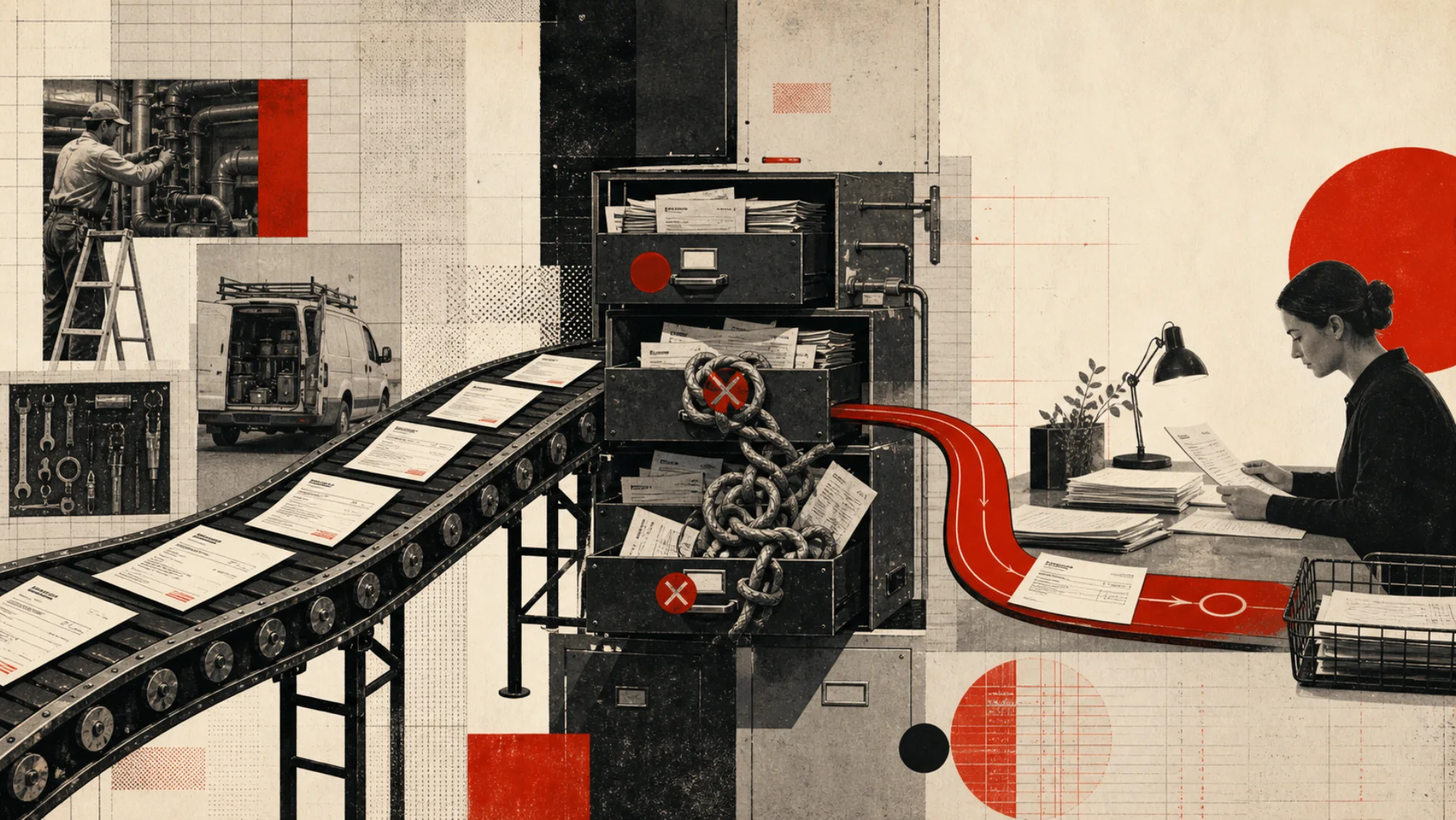
The hidden chase
The balance is visible. The management work is not.
The owner opens the aging report and recognizes the account immediately. Before sending anything, they search for the last email, ask the project manager whether punch-list work is complete, check for a partial payment, look for a missing purchase order, rewrite the reminder so it does not sound hostile, and schedule a mental note to check again Friday.
That is the invoice-recovery workflow. Automating only the email ignores most of the work and can magnify bad data. The useful system verifies the balance, preserves context, gives the customer an easy way to pay or explain, records promises, and escalates exceptions with the relationship intact.
The useful part is not sending more reminders. It is finding out whether the customer needs a link, a document, a correction, or a real conversation.
Invoice 1842 / illustrative aging record
The overdue balance is only one part of the truth.
Before another reminder leaves, the record must explain what is owed, what the customer has already said, and which resolution lane now owns the account.
Verified balance
$8,400 / 18 days overdueCustomer context
Payment blocked by missing POReminder state
Paused after replyHuman owner
Maya to supply PO by 2 PMAccounts-receivable control line
Accuracy before cadence. Resolution before pressure.
The system should make the truth easier to see for both sides. It must never send a confident reminder from uncertain data.
Verify
Amount, contact, terms, delivery
Segment
Age, size, history, dispute
Remind
Helpful to direct, by rule
Resolve
Pay, dispute, documents, promise
Escalate
Relationship and legal judgment
Human judgment stays hereLearn
Repair upstream causes
What I would look at first
Verify the debt before you increase the tone.
Delivery before delinquency
Confirm the correct customer received the correct invoice and any required supporting documents before labeling the account late.
Segment the relationship
A long-term commercial account waiting on a PO should not receive the same path as an unknown customer ignoring a deposit request.
Make disagreement easy
Every reminder needs a clear path for scope questions, missing documents, credits, partial payments, and vendor setup—not only a payment button.
Repair the source
Recurring late-payment reasons often reveal weak onboarding, scope, approval, or billing processes that another reminder cannot solve.
The practical guide
Take what is useful
Make it easy to pay, explain, or reach the right person.
A practical way to get the invoice right, make payment easy, surface problems early, and keep a real person involved when the relationship needs judgment.
Late invoices create invisible management work
An overdue invoice rarely sits still. Someone checks the accounting system, searches for the last email, asks a project manager whether the work is complete, drafts a reminder, waits, follows up again, and explains the situation to the owner. The unpaid balance is visible. The attention consumed by chasing it is not.
The useful fix is not a more aggressive reminder. It is a clean path where the balance is correct, paying is easy, the customer can explain what is blocking approval, and a real person takes over when the relationship or the facts need judgment.
Fix invoice accuracy before automating reminders
Automation magnifies bad data. Confirm that invoices have the correct customer, contact, amount, terms, purchase order, tax treatment, service detail, payment instructions, and delivery status. Make sure credits, partial payments, and disputed charges update the source system promptly.
Choose one accounting platform as the balance authority. The reminder system may read and write workflow data, but it should never maintain a competing version of what is owed. Every message must reflect the current ledger at send time.
Design a sequence that matches the relationship
A useful sequence begins before the due date with delivery confirmation or a friendly upcoming-due reminder when appropriate. After the due date, tone can progress from helpful to direct: the invoice appears outstanding, here is the secure payment path, please tell us if anything is incorrect, and here is who can resolve a question.
Segment by customer type, invoice size, age, terms, history, and account owner. A long-term commercial account with a purchase-order delay should not receive the same path as an unknown customer who ignored a deposit invoice. Approved escalation rules protect consistency without flattening every relationship.
Make it easy to pay or explain
Include invoice number, amount due, due date, company identity, and a secure payment or invoice-view link. Do not send sensitive financial details in plain text when a secure portal is available. Give the customer a clear reply path for disputes, missing documents, vendor setup, or payment timing.
Classify replies into paid, payment promised, dispute, documentation needed, wrong contact, hardship, and needs human review. AI can summarize a long reply, but a person should approve credits, term changes, legal threats, and relationship-sensitive decisions.
When somebody promises a date, remember the promise
When a customer says payment will arrive Friday, record the promised date, amount, method, owner, and source message. Pause the standard reminder sequence. Check the ledger after the promise date and either close the item or create a focused follow-up.
This simple state prevents embarrassing messages that ignore the customer's response. It also reveals patterns: repeated broken promises, processing delays, or accounts that consistently require a particular document before payment.
Escalation should be explicit and reviewable
Define thresholds by days overdue, balance, risk, dispute status, and customer importance. Escalation may mean an account-manager call, service hold review, formal demand, collections review, or legal advice. Do not let a model choose or send high-consequence action on its own.
Keep a full communication history. If a customer disputes the balance or the relationship deteriorates, the business should be able to see what was sent, when, based on which ledger state, and who approved each exception.
What to watch besides the overdue total
Track aging by bucket, total overdue balance, invoices entering and leaving each stage, average days to pay, recovery after each touch, disputes, promised payments, broken promises, incorrect-contact rate, and human time spent. Cash recovered matters, but so does the reduction in manual chasing.
Review the reasons behind late payment. Slow approvals may point to missing purchase orders. Frequent disputes may point to poor scope documentation. Wrong contacts may point to weak onboarding. Invoice automation can expose upstream operating problems that no reminder template can solve.
Polite persistence is an operating advantage
Good invoice follow-up is accurate, timely, and easy to answer. It gives customers a professional way to pay or explain a problem, and it stops making the owner remember every loose end.
Start with one aging segment and a conservative sequence. Validate every balance, watch every reply, and compare recovery against the prior process. The goal is not aggressive collections by machine. It is fewer invoices forgotten because follow-up depended on someone remembering.
Illustrative dispute lane
Payment follow-up should make resolution easier.
- 01 / Customer
“We received the invoice, but accounts payable cannot release it without the PO reference.”
- 02 / Finance desk
“Understood. I’m pausing reminders and routing the missing PO to Maya.”
- 03 / System note
“Documentation needed. Owner: Maya. Due: 2 PM. Standard cadence stopped.”
What this changesThe customer is not treated as delinquent while the business fixes its own missing document.
Tone ladder
Firmness can increase without losing accuracy or dignity.
Timing, wording, channel, and escalation must follow the company’s approved policy and applicable requirements.
Confirm delivery
‘Invoice 1842 is due next Friday. I’m checking that it reached the right person with the service report and purchase-order reference you need.’
Make action easy
State the invoice, verified balance, due date, secure payment path, and who can resolve a discrepancy. Avoid vague ‘friendly reminder’ fog.
Ask for resolution
‘Our records still show $8,400 outstanding. Please use the secure link, reply with the payment date, or tell us what is preventing approval.’
Move to a person
A dispute, broken promise, strategic account, legal threshold, or hardship exits standard automation and enters the approved human process.
Cash-recovery model
How much verified overdue cash could re-enter motion?
This is a sizing tool, not a collections guarantee or legal recommendation.
Want to use your own numbers?
Potential cash returned to motionPut in a few real numbers and get a quick estimate. It is a place to start a useful conversation, not a promise.
Open the calculator Track aging, disputes, promises, corrections, and days-to-pay alongside cash received.Where this breaks
A wrong reminder damages cash and trust.
- Reminding from stale or disputed balances
- Sending sensitive detail through insecure channels
- Treating every customer relationship the same
- Allowing automation to cross legal or policy thresholds
Humans stay in control
Disputes, promises, and escalation need ownership.
- Finance owns the verified source of truth
- Disputes and strategic accounts receive named ownership
- Legal escalation is never improvised by AI
- Promise-to-pay changes are recorded, not remembered
Bring earned revenue home
Return to the opening scene
Polite persistence needs a truthful ledger.
Return to the owner reconstructing invoice context from memory. The new path verifies the balance, recognizes the missing PO, pauses the wrong reminder, and gives one person a deadline to resolve the actual blocker.
What becomes clearer
- What entered
- A verified overdue invoice
- What changed
- The payment blocker became explicit
- Who owns it
- Finance or named account owner
- What happens next
- Pay, dispute, promise, or escalate
- When automation stops
- Any reply, dispute, or policy threshold
Try this in the next 15 minutes
Monday morning: choose ten overdue invoices from one aging bucket. Verify contact, balance, terms, delivery, and known disputes before designing the first reminder.