The owner should not be the glue between every tool and person
When Every Question, Approval, and Loose End Comes Back to the Owner
When Every Question Ends Up With You
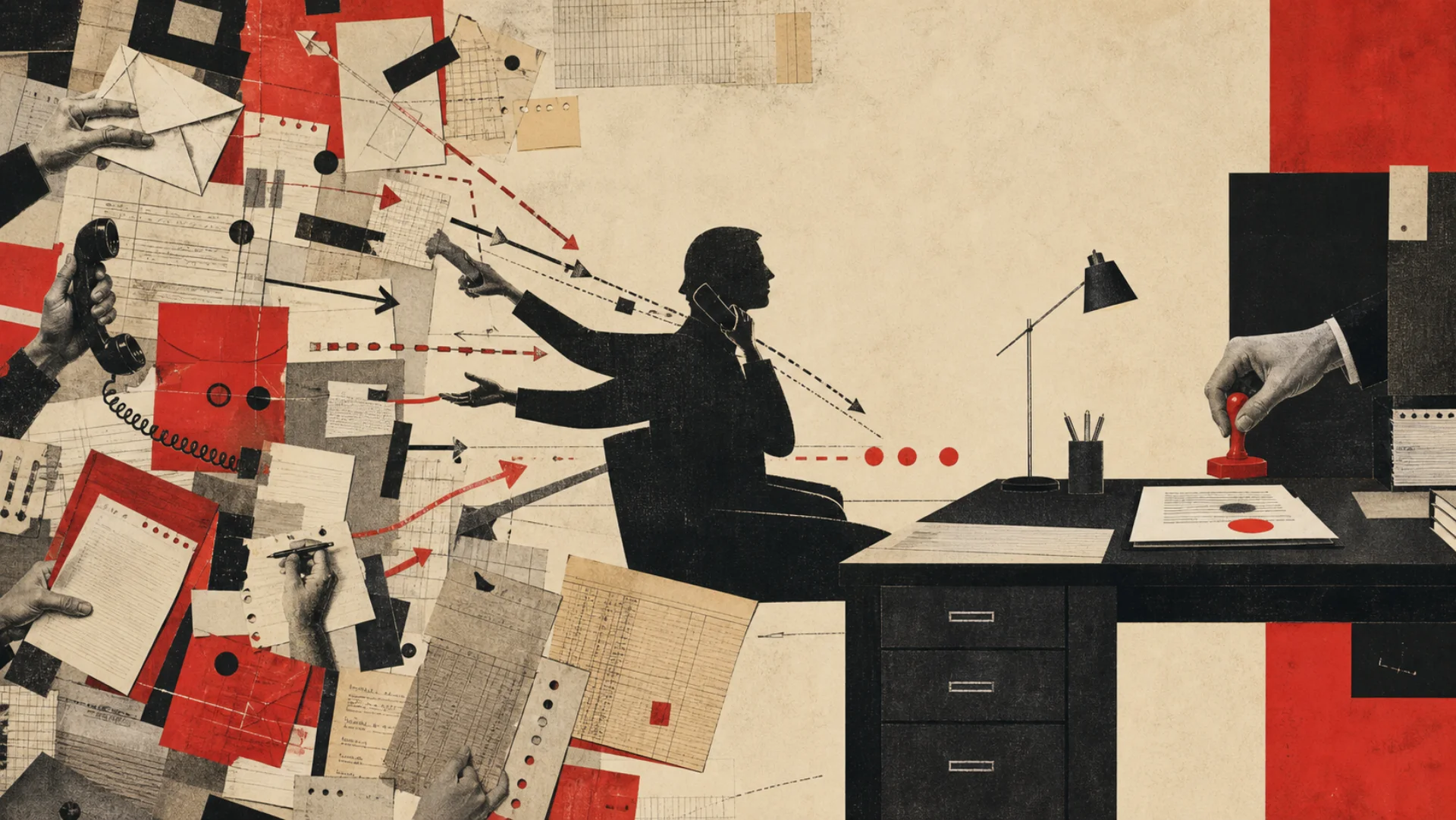
If every unclear email, meeting promise, approval, and customer exception ends up in your head, the real problem is not your inbox. The business is using your attention to connect everything else.
inputs reduced to real decisions
daily decision desk
approval for money, people, promises
A morning inside the integration layer
Before 9:12 AM, the owner has already changed jobs eleven times.
A customer wants an exception. A vendor needs approval. Two meeting commitments never became tasks. An employee texts a photo without context. The inbox contains a renewal, a complaint, a calendar change, an invoice, and four messages that look urgent but are not. The owner remembers which relationships are fragile and which promises were made verbally.
The goal is not an AI assistant pretending to be you. It is a calmer way to sort the noise, catch commitments, prepare a few drafts, and put the real decisions in one place with enough context for you to act.
Let AI help sort and prepare the work. Do not let it quietly become the person talking to your best customers.
9:12 AM / illustrative owner brief
Forty-seven inputs become five decisions.
The desk earns trust by removing reconstruction. Every item carries the source, consequence, proposed action, and boundary the owner needs to decide quickly.
Customer exception
Decision needed by 11:00Vendor approval
Drafted from verified quoteMeeting promise
Owner missing, cannot create taskRoutine updates
31 archived or delegatedThe owner decision desk
Collect the inputs. Keep judgment visible.
The system is useful when it reduces search and reconstruction—not when it hides activity behind the word autonomous.
Collect
Inbox, meetings, forms, alerts
Context
Source, relationship, commitments
Triage
Delete, delegate, draft, decide
Prepare
Summary, options, reversible draft
Approve
Owner decides what matters
Human judgment stays hereRecord
Task, response, owner, due date
What I would look at first
Five queues keep noise away from judgment.
Delete
Noise, duplicate alerts, and informational messages should leave the owner’s attention without creating another task to manage.
Delegate
Route work with the source, required outcome, owner, deadline, and reason—not a vague forward that makes somebody else reconstruct context.
Draft
Prepare a response from verified facts and approved voice examples. Label uncertainty. The owner edits and sends until trust is earned.
Decide / escalate
Money, people, commitments, strategy, conflict, and unusual customer situations remain explicitly human.
The practical guide
Take what is useful
Build a decision desk, not a second inbox.
A grounded way to sort the inbox, catch meeting promises, prepare drafts, and give the owner fewer—but better—decisions to make.
The owner becomes the integration layer
In a growing service business, information travels through the owner because the systems do not. Customers email, employees text, meetings create commitments, vendors ask questions, and software produces alerts. The owner remembers the relationships and exceptions, so every unclear handoff becomes another decision waiting in their head.
I am not talking about an AI assistant that secretly runs the company or pretends to be you. I am talking about sorting the noise, catching the promises, preparing a few drafts, and giving you one short list of decisions while you keep control of money, people, customers, and strategy.
Measure the attention leak
For one week, log administrative switches rather than just hours: opening the inbox to find one message, searching meeting notes, retyping a task into another system, asking who owns a follow-up, and drafting the same category of response. Frequent context switching is often more damaging than any single task.
Group the work into triage, extraction, routing, drafting, scheduling, retrieval, and decision. The safest first jobs are high-frequency, reversible, and easy to review. Start there before touching sensitive customer promises, personnel issues, contracts, or financial approvals.
Turn the inbox into a shorter list of real decisions
AI can sort incoming email by customer, urgency, project, requested action, deadline, and owner. It can summarize a long thread, find the unanswered question, and prepare a task. Every item should still link back to the original message so you can see why it landed there.
Define categories that match the business: owner decision, team action, customer reply needed, finance, vendor, scheduling, information only, and low-value noise. Create escalation rules for legal language, complaints, safety, refunds, employee matters, and high-value accounts. Those messages should never wait inside an automated digest.
Meeting notes should become commitments
A transcript is not an operating outcome. After a meeting, extract decisions, action items, owner, due date, dependencies, open questions, and the source moment. Send a concise review to the meeting owner before writing tasks into shared systems.
Use consistent language: decided, proposed, assigned, and unresolved are different. AI frequently turns discussion into false certainty. Human review protects the team from tasks nobody accepted and decisions nobody made.
Draft responses without impersonating the owner
Build a small library of approved voice examples and response patterns: acknowledgement, status update, request for missing information, scheduling handoff, polite decline, and internal direction. Drafts should use verified facts from the source thread and label assumptions or missing information.
Keep every external message in draft until approved during the first phase. Later, low-risk acknowledgements may qualify for automatic sending, but promises about price, timing, scope, employment, legal position, or customer recovery should remain human decisions.
Create one daily command brief
The highest-value output may be a twice-daily brief: urgent items, decisions needed, overdue commitments, customer risks, today's meetings, waiting-on items, and drafts ready for approval. Every item should link back to its evidence and have a clear next action.
The brief must be short enough to use. If it becomes a second inbox, the system has failed. Rank by consequence and deadline, collapse low-value updates, and let the owner correct classifications so the operating model improves.
Security and boundaries are part of the product
Connect the minimum systems required and grant the minimum permissions. Separate personal from business data. Define retention, logging, and who can see summaries. Exclude protected, privileged, medical, financial, or employment information unless the system and policy are designed for it.
Maintain an action log showing source, proposed action, approval, execution, and result. Use separate service identities rather than the owner's personal login. A useful admin system should make accountability clearer, not hide activity behind an assistant persona.
Measure capacity returned to leadership
Track triage accuracy, drafts accepted, tasks captured, overdue items prevented, median response time, urgent items escalated, corrections, and owner minutes spent on the queue. Ask a harder monthly question: Did the owner spend more time on customers, people, and decisions that only they can make?
Begin with one inbox and one meeting type. Earn trust through visible drafts and reversible actions. Owner Admin Relief becomes powerful by being dependable and boring in the background—not by pretending judgment no longer matters.
Illustrative decision tray
A useful draft shows you what is missing. It does not make it up.
- 01 / Owner
“Can we promise the customer a Friday completion?”
- 02 / Decision desk
“The draft says Friday, but no schedule source confirms crew capacity.”
- 03 / System note
“Owner decision required. Draft held. Operations context requested.”
What this changesThe owner spends attention on the real promise instead of discovering an invented fact after it is sent.
One controlled day
The help should show up when you need to decide, then get out of the way.
Start with one inbox and one kind of meeting. You will learn more from a small, useful test than from connecting everything at once.
Decision brief
Five items need judgment, three drafts are ready, two commitments lack owners, and one customer issue crossed the escalation rule. Every item links to the source.
Meeting extraction
The system proposes decisions, actions, owners, dates, dependencies, and unresolved questions. The meeting owner accepts or corrects before tasks are created.
Draft window
Routine acknowledgements and status updates arrive in one review queue. Assumptions and missing facts are visible instead of being smoothed into confident prose.
Loop closure
Approved responses are sent, commitments are recorded, delegated work is acknowledged, and tomorrow’s genuine decisions are separated from background noise.
Leadership-capacity model
What is fragmented attention costing the company?
Value the owner’s recovered decision time conservatively. The goal is better leadership use, not theoretical time savings.
Want to use your own numbers?
Annual leadership capacity returnedPut in a few real numbers and get a quick estimate. It is a place to start a useful conversation, not a promise.
Open the calculator Use 48 working weeks to avoid pretending every reclaimed hour is monetized every week of the year.Where this breaks
A confident draft without evidence is a liability.
- Connecting every channel before defining boundaries
- Writing tasks directly from unreviewed transcripts
- Sending drafts that invent missing facts
- Measuring activity instead of leadership capacity returned
Humans stay in control
The owner is the judgment layer.
- Money, people, promises, and strategy require approval
- Every draft links back to source evidence
- Owners can see and change routing rules
- The system starts with reversible actions and visible correction
Return the owner to leadership
Return to the opening scene
The owner should be the judgment layer, not the integration layer.
Return to 9:12 AM. The same customers, vendors, meetings, and exceptions still exist. What changes is the owner’s job: five evidence-backed decisions replace forty-seven fragments that each demanded reconstruction.
What becomes clearer
- What entered
- Inbox, meetings, alerts, and requests
- What changed
- Noise became a consequence-ranked brief
- Who owns it
- Team actions route before owner review
- What happens next
- Delete, delegate, draft, decide, escalate
- When automation stops
- Money, people, promises, or missing facts
Try this in the next 15 minutes
Monday morning: log every context switch until lunch. Mark each one delete, delegate, draft, decide, or escalate, then choose the single queue with the most repeatable rules.